Serve the whole stack.
The Chip Sleeve is a full-length insert that carries every chip out of the canister in one motion. It is a licensable in-pack feature, not a new package: same canister exterior, proposed single-module line integration, from 3 to 6 grams of added material depending on substrate.
0 mm
Exterior change
1-module concept
Line integration
3–6 g
Added mass
Product Demonstration
Fits the canister you already make and fill today.
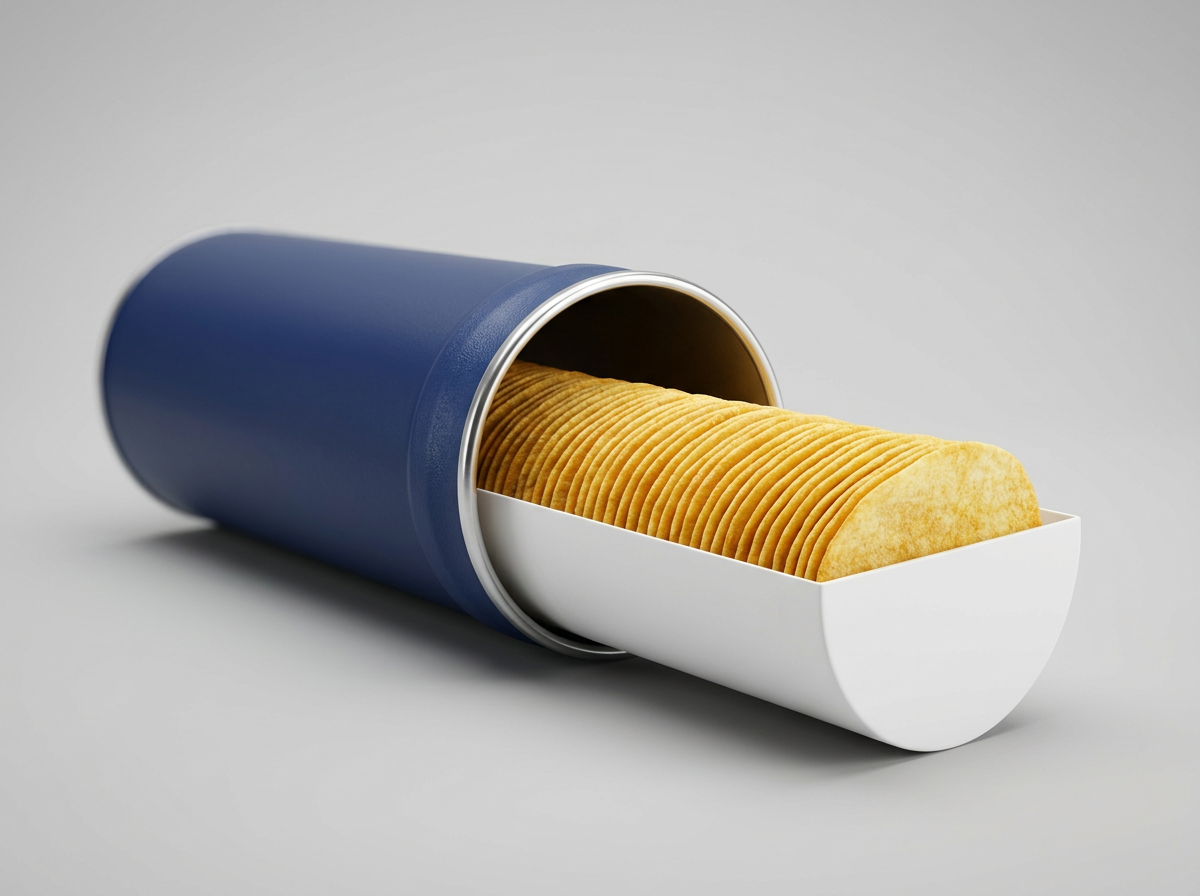
Proof of Concept
The mechanism is already proven in a physical prototype.
The first Chip Sleeve was formed from a single sheet of food-safe stock and fitted into an off-the-shelf canister. Tipped on its side, the sleeve carries the entire stack out in one motion — aligned and reachable from the first chip to the last. No lid, no latch, no second component.
- — Runs the full interior length of the canister
- — No lid, no latch, no added parts
- — Loads and unloads through the existing open end
The canister's one unsolved complaint is the reach — and it is fixable from the inside.
Hands never enter the tube. Chips slide out without dumping or tipping, and the pack format itself never changes.
No package redesign
The insert lives entirely inside existing canister geometry. Artwork, tube tooling, case count, pallet pattern, and shelf footprint are all untouched.
No dumping or reaching
The insert brings the full stack within easy reach, so consumers can take chips from top to bottom without tipping the can, dumping it out, or reaching down inside.
A defensible claim
A patent-pending, on-pack-provable benefit that competitors cannot copy — usable in launch communication, limited editions, and accessibility positioning.
What is on the table
The inventor is seeking a licensee, not a co-manufacturer. Terms are open: category or geographic exclusivity, per-unit royalty, or outright assignment.
Exclusivity, defined by you
Category or territory exclusivity in the stacked-chip segment — North America, EMEA, or global — with a pilot SKU before any full rollout commitment.
Material path to your ESG targets
Food-grade plastic (PP, PET, rPET) or paperboard. The sleeve is designed to be formed from either substrate, so the mass and recycling stream can match your existing pack specification.
Proposed single-module integration
The sleeve can be staged at the transfer chute and inserted with the counted chip slug in the same push stroke. The goal is no second station and no line-speed penalty — both to be validated on the OEM's actual line.
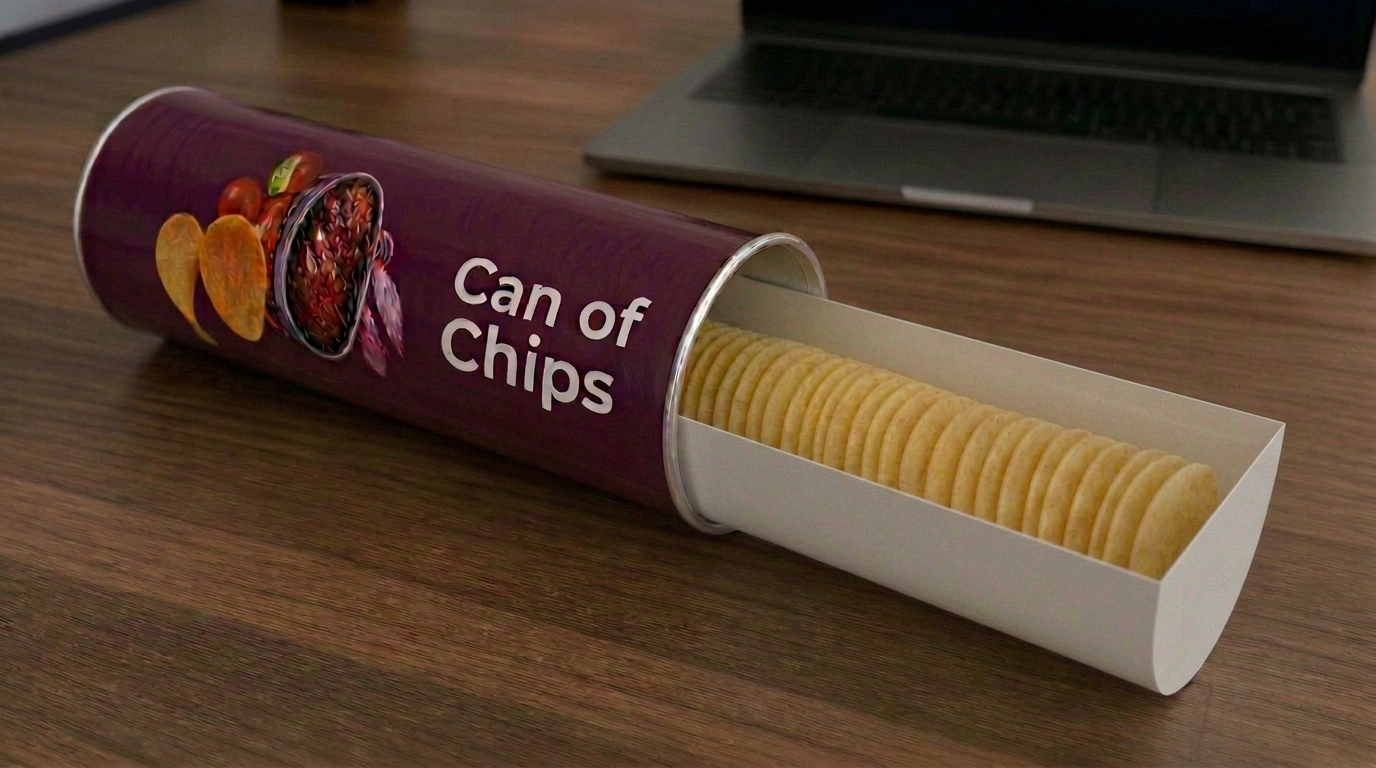
Two Ways to Partner
Same insert. Two paths to market.
The Chip Sleeve is one design with two routes to the consumer — and a partner can pursue either, or both.
Path 1 · In-Pack
Integrated during line production
The sleeve is inserted on the filling line and ships inside every canister — the scalable endgame. One proposed module, no canister change, no line-speed penalty target.
- — In every can, at full line scale
- — No change to the canister exterior or shelf footprint
Path 2 · Retail Accessory
Sold separately near the chip aisle
The same insert can be manufactured independently and offered as a branded display piece near stacked-chip canisters — a low-risk trial with no line changes and no retooling.
- — Zero production-line commitment to start
- — Real consumer demand data before in-line integration
A retail accessory launch can build the proof of demand that makes the in-line decision easy — the two paths reinforce each other.
Dimensioned and documented.
Geometry is parametric on canister inside diameter, so a single tool family covers slim, standard, and large canister SKUs with no change to the canister itself.
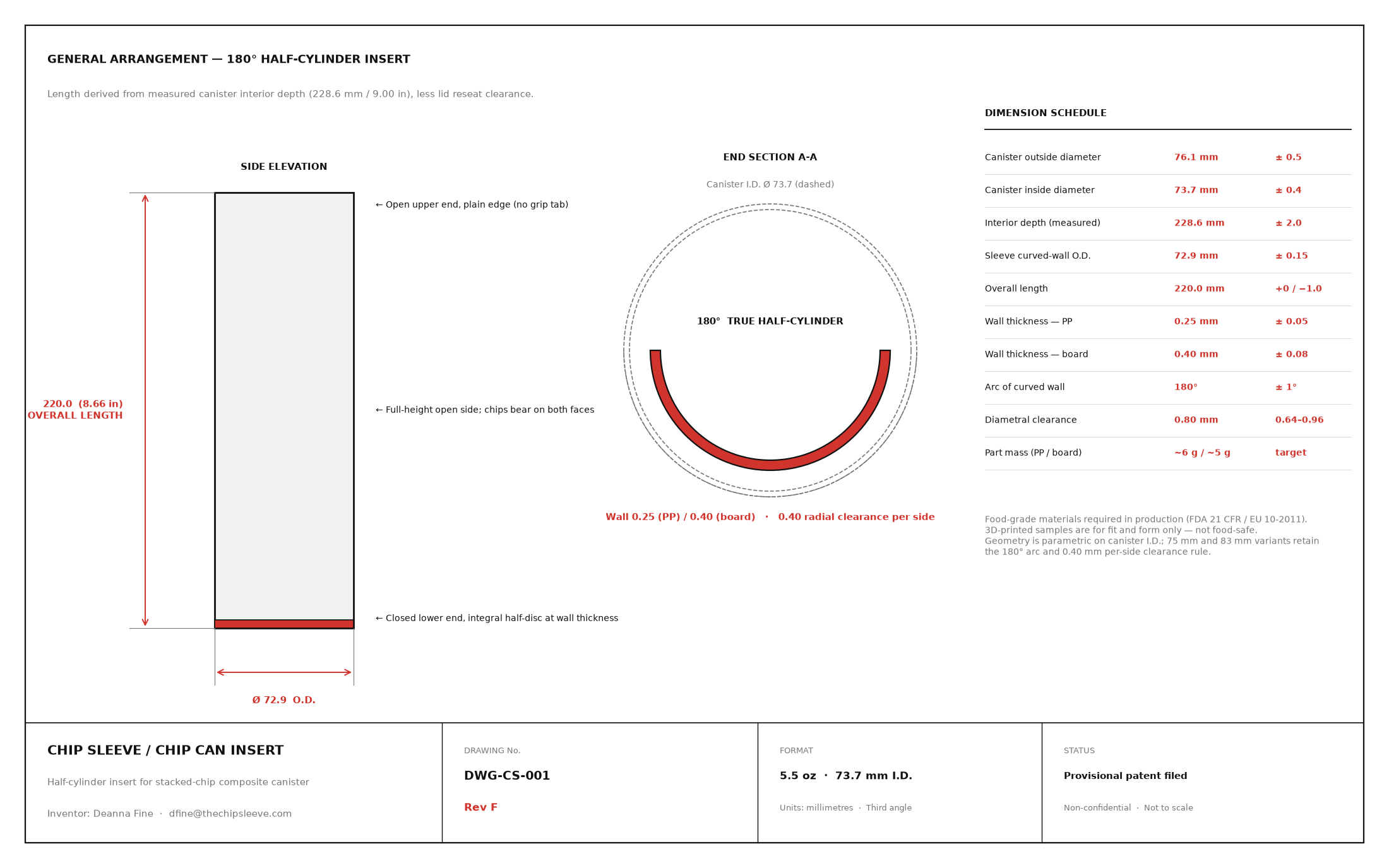
Curved wall O.D.
72.9 mm
Overall length
220.0 mm (8.66 in)
Wall thickness
0.25 mm
Part mass
PP: ~6 g · Board: ~5 g
DOC-CS-100 Rev C
Technical Whitepaper
Problem statement, design invariants, dimensional derivation, materials, cost model, and line integration concept.
Download PDF ↓DOC-CS-200 Rev C
CAD Documentation
Parametric model definition, tolerance stack, tooling notes, and the delivered CAD file manifest.
Download PDF ↓DOC-CS-300 Rev C
Prototype Kit Guide
Bill of materials, heat-formed build procedure, fit checks, and the evaluator scoring sheet.
Download PDF ↓Proposed: one slug, one stroke.
Composite canisters fill through the open base end — the top foil and lid are applied first, a counted chip slug is pushed in horizontally, then the metal base is seamed under nitrogen. The Chip Sleeve concept joins that slug before the loader, so stack and sleeve could enter the can in the existing push stroke. This is an engineering hypothesis only; final machine configuration, timing, and throughput must be validated with the OEM's line engineer.
Exterior change
0 mm
New equipment
1 module (concept)
Line speed target
No penalty
Added part mass
PP: ~6 g · Board: ~3 g
Diligence-ready today
Whitepaper, dimensioned drawing, CAD package, and prototype build guide are downloadable above. Native CAD files and a physical sample kit are available on request under NDA.
Utility Patent
Provisional Application Filed
Filed by inventor Deanna Kallison Fine on the half-cylinder (D-profile) insert — closed lower end, open upper end, and a full-height open side — plus the tilt-and-withdraw dispensing method. Full specification and claims available under NDA.
Materials
Plastic or Paperboard
Food-grade PP / PET / rPET or paperboard substrate. Both options meet standard FDA and EU food-contact requirements and can be specified to match the target recycling stream.
Compatibility
75mm & 83mm Canisters
Parametric geometry: one tool family covers slim, standard, and large composite canister SKUs with no canister change.
The Inventor
Deanna Fine
Deanna Fine is an independent inventor and the creator of the Chip Sleeve, a patent-pending insert for rigid stacked-chip canisters. She conceived, dimensioned and prototyped the sleeve from a simple observation: nobody should have to tip, shake, or reach a hand down inside the tube to get to their chips.
She filed the provisional patent, developed the CAD package and technical whitepaper, and produced the first physical prototypes. She is also the founder of GlowUp, a beauty professional directory.
Direct contact: dfine@thechipsleeve.com